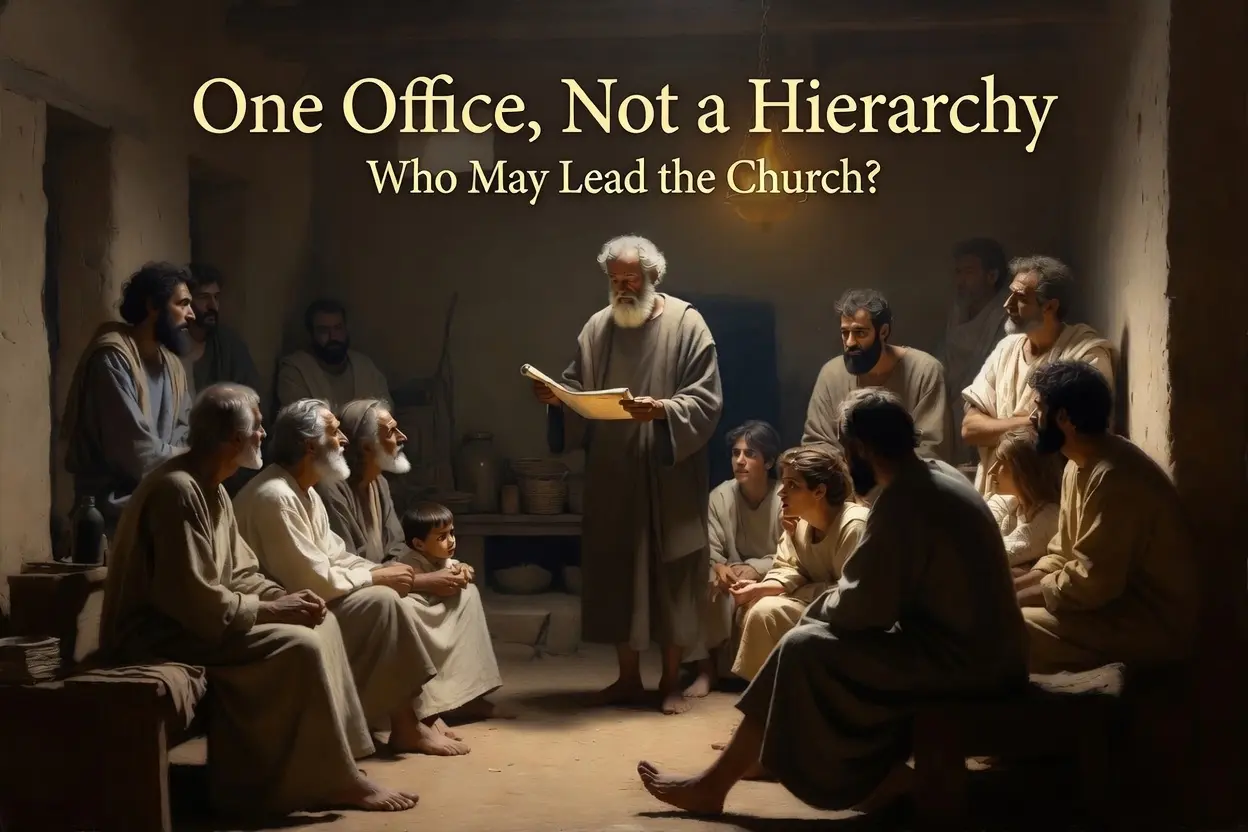
Few subjects have been more thoroughly buried under tradition than the simple matter of who leads a local grace assembly and what that man is supposed to be. The religious world has built cathedrals of titles on top of a handful of plain verses — archbishops over bishops, a pope over them, a clergy raised above a laity, ordination treated as a sacrament that turns an ordinary man into a mediator. None of that is in Paul. What is in Paul is a plain description of a responsibility, the standard that responsibility carries, and the orderly way a church recognizes the men fit to carry it. This study works through it from Paul: what the qualifications actually are and how to read them, whether "bishop" and "pastor" name two different things, what the office is actually for and how teachers relate to it, what happens when a man already in the office no longer measures up, whether the apostle of grace teaches ordination at all, and — if he does — who appoints elders today and how.
Two offices, not a hierarchy
Before the qualifications, notice how few offices Paul actually names. When he greets a whole assembly he writes:
"Paul and Timotheus, the servants of Jesus Christ, to all the saints in Christ Jesus which are at Philippi, with the bishops and deacons." (Philippians 1:1 KJV)
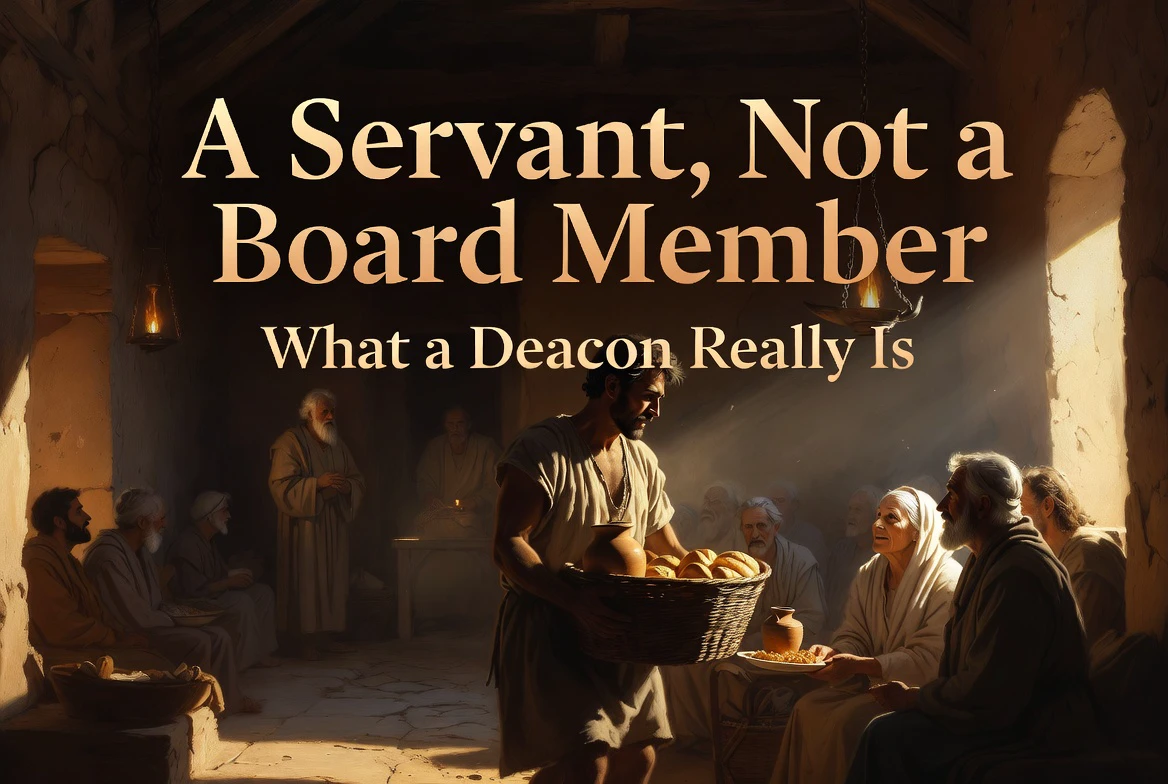
Saints, bishops, and deacons. That is the entire structure. The servant office is taken up in full in The Deacon: A Servant in the House of God — why the deacon serves rather than rules or teaches. There is no rank above the bishop in the local church. People come to this chapter looking for the man over him, the one who anoints him from a higher tier, and there simply is not one. Note, too, that both nouns are plural — bishops and deacons — a detail we will return to when we ask how the oversight of a city's saints was distributed. The deacons serve; the saints are complete in Christ. So Paul gives us exactly two offices — the bishop and the deacon — and we will see in a moment that the first of those is the same man the Bible also calls the elder, the overseer, and the pastor.
The qualifications of a bishop
The two great lists are 1 Timothy 3 and Titus 1. Paul opens the first this way:
"This is a true saying, If a man desire the office of a bishop, he desireth a good work. A bishop then must be blameless, the husband of one wife, vigilant, sober, of good behaviour, given to hospitality, apt to teach; Not given to wine, no striker, not greedy of filthy lucre; but patient, not a brawler, not covetous; One that ruleth well his own house, having his children in subjection with all gravity; (For if a man know not how to rule his own house, how shall he take care of the church of God?) Not a novice, lest being lifted up with pride he fall into the condemnation of the devil. Moreover he must have a good report of them which are without; lest he fall into reproach and the snare of the devil." (1 Timothy 3:1–7 KJV)
Titus repeats the same standard, written to a man Paul left in Crete to set things in order, and adds a few strokes of its own:
"If any be blameless, the husband of one wife, having faithful children not accused of riot or unruly. For a bishop must be blameless, as the steward of God; not selfwilled, not soon angry, not given to wine, no striker, not given to filthy lucre; But a lover of hospitality, a lover of good men, sober, just, holy, temperate; Holding fast the faithful word as he hath been taught, that he may be able by sound doctrine both to exhort and to convince the gainsayers." (Titus 1:6–9 KJV)
Put the two together and the picture is a man whose private life, family, appetites, temper, money, and doctrine are all in order, and who can both teach the truth and answer those who fight it. But here is where almost everyone goes wrong, and where rightly dividing matters. This list is not a scorecard of personal perfection that some elite Christian has aced. Paul says it is the description of an office — the standard the responsibility itself carries. Notice his exact words: not "the man must be blameless" but "a bishop then must be". He is describing the shoe, not measuring the foot. It reads much the way Romans 6 reads when it says you are a servant of righteousness who no longer serves sin — a true description of your position that you do not flawlessly live out every hour, and which therefore drives you back to grace rather than to law. The same is true here. The shoe is deliberately too big for any one man to fill on his own; that is what keeps the office from becoming a pedestal. The qualified man is not the one who has scored highest on a law, but the one who genuinely desires the good work and is able and apt to do it — chiefly, to guard sound doctrine and keep the church in order.
The heart of it: desiring a good work
That first verse controls all the rest. "If a man desire the office of a bishop, he desireth a good work." The object of the desire is the good work, not the title or the authority. This is the same desire Paul commends to every believer when he says we are Christ's workmanship, "created in Christ Jesus unto good works, which God hath before ordained that we should walk in them" (Ephesians 2:10 KJV). So the way you tell whether a man should lead is not whether he announces "I want to be the pastor" or "I want to be in charge" — it is whether he loves and pursues good works in the first place. A man who spurns good works disqualifies himself at verse one, before you ever reach the list. A man who delights in them is the kind of man grace can help carry a responsibility no man carries perfectly. The whole chapter, read this way, is finally about grace — the last thing most people expect to find in it, because they come to it hunting for a reason to disqualify somebody.
The office is for men
One feature runs quietly through both lists: the officeholder is a man. He is "the husband of one wife" and one that "ruleth well his own house" (1 Timothy 3:2, 4 KJV) — a husband and the head of a household, not a wife or a child within it. This is no relic of ancient custom that a later age may revise, for Paul grounds it where it cannot be moved, in the order of creation itself: "But I suffer not a woman to teach, nor to usurp authority over the man, but to be in silence. For Adam was first formed, then Eve" (1 Timothy 2:12–13 KJV). The office is exactly teaching and authority in the assembly — the two things reserved here to the man — so the bishop is a man.
This takes nothing from the worth or the ministry of godly women, which Paul honors without reserve: women "laboured with me in the gospel" (Philippians 4:3 KJV), and the aged women are to be "teachers of good things," training the younger (Titus 2:3–4 KJV). The point is not that a woman may not serve, or teach, or lead in her own God-given place, but that the office of oversight and rule in the assembly belongs to men. To reverse it — setting a woman over the man at church while the man is the head at home (Ephesians 5:23) — only tangles the order God Himself has set.
Bishop, elder, overseer, pastor — one office or several?
Are these titles a ladder of separate ranks? They are not. They are different words describing the same man and his one office, each catching a different angle of the same work.
The clearest proof is in Titus 1 itself. Paul tells Titus to "ordain elders in every city" (Titus 1:5 KJV), and then, giving the standard for those very men two verses later, he writes "For a bishop must be blameless" (Titus 1:7 KJV). He starts the sentence talking about elders and finishes it talking about a bishop, because they are the same person. The same identity appears in Acts 20, where Paul "sent to Ephesus, and called the elders of the church" (Acts 20:17 KJV) and then tells those same men, "the Holy Ghost hath made you overseers, to feed the church of God" (Acts 20:28 KJV). Elders, overseers, feeding the flock — all one group of men.
The words simply emphasize different things. "Elder" points to the man — his maturity, dignity, and standing. "Bishop" is the overseer — the very word Paul uses for these men in Acts 20:28 — and points to the function of watching over and guarding. "Pastor" carries the picture of the shepherd, and points to the care of feeding and tending the flock. Paul himself fuses them at Miletus, where he calls for the elders of the church and charges those same men, as overseers, to feed the church of God (Acts 20:17, 28). One man; three pictures of his job.
So "pastor" is not a higher or separate office from "bishop." In fact Paul only uses the word once, and there it is paired with teaching as a gift Christ gave: "And he gave some, apostles; and some, prophets; and some, evangelists; and some, pastors and teachers" (Ephesians 4:11 KJV). That is a gift of shepherding-and-teaching for building up the body, not a clerical rank stamped on a business card. The title itself does not matter; what matters is the work a man does, not what he is called. This deserves a careful word, because a good deal of needless heat gets spent forbidding particular titles. "Reverend" is the usual case: it is often said the word may never be applied to a man because Scripture uses it once, of God — "holy and reverend is his name" (Psalm 111:9 KJV). But there it is plainly an adjective; it tells us God's name is to be revered, and is no personal title at all. As an English word, "reverend" entered the language around the year 1400 meaning simply "worthy of respect," and only later settled onto the clergy as a courtesy form of address; to forge a doctrine against that courtesy title out of a single adjective is to make far more of the word than the verse does. And the argument collapses on its own verse, for its companion word disproves the rule: "holy" stands in the very same clause, said of the very same name — yet Paul freely calls the saints holy, the "holy brethren" (1 Thessalonians 5:27 KJV), "holy and beloved" (Colossians 3:12 KJV). If a word were fenced off from men merely because it is true of God, no believer could ever be called holy; but every believer is.
The same lesson runs through the title "Father." Paul never wears it as a title of address, yet he is unmistakably a spiritual father in fact: he tells the Corinthians, "in Christ Jesus I have begotten you through the gospel" (1 Corinthians 4:15 KJV), warns them "as my beloved sons" (1 Corinthians 4:14 KJV), calls Timothy "my own son in the faith" (1 Timothy 1:2 KJV), names Onesimus "my son… whom I have begotten in my bonds" (Philemon 10 KJV), and labors over his converts "as a father doth his children" (1 Thessalonians 2:11 KJV). The work of fathering in the faith is real and good, and Paul claims it.
What he does not do is turn it into a title that exalts him. That is the very thing the Lord forbade in "call no man your father upon the earth" (Matthew 23:9 KJV) — words spoken to Israel under the kingdom, and aimed not at natural parentage or ancestry (the same people rightly said "Father Abraham", and Paul calls Abraham "the father of us all," Luke 16:24; Romans 4:16 KJV) but at the religious title, the spiritual master set over men's souls. A man may truly father others in the gospel, as Paul did, and take no honor to himself; what he must not do is wear the family name of God's household as a badge of rank.
The caution that actually matters, then, is not about a word but about a spirit. "Pastor" is not wrong — the ideas of leading and feeding the flock are genuinely in it, and Scripture plainly sets such men "over you in the Lord" (1 Thessalonians 5:12 KJV), to be known, esteemed, and followed as they follow Christ.
What is wrong is the abuse of that leadership into a clergy lifted above a laity — "I'm the pastor, you're the sheep, follow me bleating along" — where the man becomes a caste apart, a mediator, a holier sort nearer to God than the rest. That is what runs backwards under grace, for there is "one mediator between God and men, the man Christ Jesus" (1 Timothy 2:5 KJV), the saints are complete in Christ, and every believer alike has "access by one Spirit unto the Father" (Ephesians 2:18 KJV).
So the leader is genuinely over the flock in responsibility and example, yet not above it in standing; he leads as one of the brethren who has taken up a work, not as a priest on a pedestal. The danger is never the word, nor leadership itself; it is the pedestal.
A fair caution for honesty's sake: some sincere grace believers do treat Ephesians 4:11 "pastors" as a distinct foundational gift and reserve "bishop/elder" for the standing local office. The point of agreement, and the safe ground, is this — Scripture names exactly two ongoing local-church offices, bishop (elder) and deacon, and "pastor" describes the shepherding work of that same elder rather than a separate tier of authority.
Local oversight, not a clerical hierarchy
Return now to that plural in Paul's greeting: "with the bishops and deacons" (Philippians 1:1 KJV). Not "the bishop" of Philippi, but bishops — and the same plural runs everywhere the appointing is described: Paul and Barnabas "ordained them elders in every church" (Acts 14:23 KJV); Titus is to "ordain elders in every city" (Titus 1:5 KJV); and at Ephesus Paul calls for "the elders of the church" — plural elders — telling those same men the Holy Ghost had made them overseers (Acts 20:17, 28). What the plural plainly shows is that the leadership of Philippi's saints was not vested in one man over them all — Paul greets bishops, more than one, in connection with that city. That much is direct evidence, not an argument from silence, and it tells against the later invention of a clerical hierarchy — a bishop ranked over other ministers and set above the congregations of a whole city, with an archbishop above him and a pope above all. That pyramid is what the plural excludes. We should be careful, though, not to make the plural prove more than it does. It does not require every assembly to have several elders, nor does it forbid a single godly man from leading one; a small gathering — even the lone assembly of an entire town — may well have had but one bishop, and that is the presiding-elder picture, no throne and no defect. The point is narrower and surer: Scripture sets no rank of men above the bishop, and the oversight of a city's saints was never gathered up into one ruling office above the rest.
How it was distributed below that admits two honest readings, and Scripture does not force a choice between them. The first is a plurality of elders within a single congregation — several qualified men jointly overseeing one gathered assembly. The second, easy to miss from a modern vantage, follows from how the early saints actually met. They had no church buildings; the assemblies met in homes — "the church that is in their house" (Romans 16:5; 1 Corinthians 16:19; Colossians 4:15; Philemon 2 KJV) — and Paul taught "publickly, and from house to house" (Acts 20:20 KJV). A city's "church" was therefore an aggregate of household gatherings scattered across the city, and on this reading the plural "bishops" of Philippi need not mean a board over one room; it may mean one leading man for each of the city's house-assemblies. Paul's own words point that way: he writes, "If therefore the whole church be come together into one place" (1 Corinthians 14:23 KJV; cf. 11:20) — a qualifier that only makes sense if the whole church being in one place was a notable occasion, not the ordinary week.
This second reading actually fits the grace pattern better than a committee does, and better matches what we have already seen — that an assembly has a leading or presiding man. An assembly does not need fifty bishops; it has a presiding elder who takes the office and the responsibility. If each household assembly has its leading man, a city has its plural bishops without any single gathering being run by a board, and without any one man ruling them all.
Paul's word to the Thessalonians confirms both the plurality and its proper honor: "And we beseech you, brethren, to know them which labour among you, and are over you in the Lord, and admonish you; And to esteem them very highly in love for their work's sake. And be at peace among yourselves" (1 Thessalonians 5:12–13 KJV). Mark the plural again — them, not him — leaders, more than one, set among and over the saints of that city. And mark the balance the verse strikes against every excess. These men genuinely are "over you in the Lord", so the leadership is real authority and not a fiction to be leveled away; yet the esteem owed them is "for their work's sake", not for a title or a man, and it issues in peace rather than a personality cult. Real leadership, truly honored, on the ground of real labor — that is the grace mean between a pedestal and a free-for-all.
The doctrine that matters survives in either case. Oversight is local — exercised among the saints, not handed down from a hierarchy above them — with no rank of men set over the bishop and no man set upon a pedestal. Where leadership is shared, it carries an added safeguard, for then there are peers to bring correction, the very setting Paul assumes in "against an elder receive not an accusation, but before two or three witnesses" (1 Timothy 5:19 KJV). And the singular "a bishop" of 1 Timothy 3:2 is the office described in the abstract — what any man who fills it must be — not a count of how many a church must have, while 1 Timothy 5:17 shows that among those who do lead, some labor more, "especially they who labour in the word and doctrine."
A word of right division belongs here too, since the most-quoted "elders of the church" verse comes from elsewhere. James also says, "let him call for the elders of the church" (James 5:14 KJV) — but James writes "to the twelve tribes which are scattered abroad" (James 1:1 KJV), the believing remnant of Israel, and his elders anoint the sick with oil in hope of healing, which belongs to that program. The body has no need to reach for that verse; Paul himself gives all it requires concerning elders, and there we rest.
What the bishop's work actually is
If the qualifications tell us what kind of man may hold the office, the rest of Paul's instruction tells us what the office is for — and it is not a platform for a personality. It is a fourfold work, all of it carried out as a servant and not a lord: to oversee, to feed, to rule, and to guard.
He oversees. Paul charges the Ephesian elders, "Take heed therefore unto yourselves, and to all the flock, over the which the Holy Ghost hath made you overseers, to feed the church of God, which he hath purchased with his own blood" (Acts 20:28 KJV). That is the same care he has in view when he asks how a man who cannot manage his own household "shall… take care of the church of God" (1 Timothy 3:5 KJV). The elder carries the weight of the assembly's welfare, not merely his own.
He feeds. To feed the flock is to teach it sound doctrine — which is exactly why the man must be apt to teach and able to hold fast and explain the faithful word (1 Timothy 3:2; Titus 1:9). A shepherd who does not feed is no shepherd; the pastoral picture is, at bottom, a teaching one.
He rules, and is honored for ruling well: "Let the elders that rule well be counted worthy of double honour, especially they who labour in the word and doctrine" (1 Timothy 5:17 KJV). This is direction, not domination — keeping the assembly ordered, working, and moving one way, the very thing the Corinthians lacked.
He guards. Paul warns those same elders, "after my departing shall grievous wolves enter in among you, not sparing the flock. Also of your own selves shall men arise, speaking perverse things, to draw away disciples after them. Therefore watch" (Acts 20:29–31 KJV). This is why his very first charge to Timothy was to "charge some that they teach no other doctrine" (1 Timothy 1:3 KJV), and why his standing order is "Preach the word; be instant in season, out of season; reprove, rebuke, exhort with all longsuffering and doctrine" (2 Timothy 4:2 KJV). The leader's vigilance is the flock's protection against error.
And the manner of all of it is the opposite of lordship. Paul, with all his apostolic authority, would not take it: "Not for that we have dominion over your faith, but are helpers of your joy: for by faith ye stand" (2 Corinthians 1:24 KJV). He leads by going first, not by driving: "be thou an example of the believers, in word, in conversation, in charity, in spirit, in faith, in purity" (1 Timothy 4:12 KJV), and asks only to be followed as he himself follows Christ (1 Corinthians 11:1; Philippians 3:17). The bishop rules a flock he does not own and feeds those who are already complete in Christ; his authority is the authority of an example.
A word of right division belongs here, because the most familiar shepherd-passage is reached for at exactly this point. Peter, too, tells elders to feed the flock and not to lord over it — but he writes "to the strangers scattered", the believing remnant of the circumcision, and seals his charge with their kingdom hope: "when the chief Shepherd shall appear, ye shall receive a crown of glory that fadeth not away" (1 Peter 1:1; 5:4 KJV). The principle is lovely and the overlap is real, but the body of Christ takes its order from its own apostle. Everything the office needs Paul has already given, and that is where we build.
Where teachers fit
This also settles how teachers relate to the office, and it guards us from two opposite errors — making every teacher a ruler, or imagining a ruler need not teach.
Teaching is required of the elder but is not the same thing as the office. The bishop must be "apt to teach" and able "by sound doctrine both to exhort and to convince the gainsayers" (1 Timothy 3:2; Titus 1:9 KJV), so no man who cannot handle the word should lead. Yet teaching itself is a gift spread broadly through the body, needing no office or authority to exercise. Paul tells the Corinthians, "though ye have ten thousand instructors in Christ, yet have ye not many fathers" (1 Corinthians 4:15 KJV) — instructors are many; fathers, leaders, those who beget and govern, are few. A believer may teach the Scriptures privately, in writing, or online, claiming rule over no one, and be entirely in his place.
The difference is that the leader adds to teaching what a teacher as such need not carry: oversight, rule, the duty to govern behavior and confront sin, and responsibility for what the flock does with the truth. A teacher explains; a leader must also direct, protect, and answer for the direction. And here a word about the term itself is needed, for "elder" does not by itself denote the office. In Scripture an elder is first simply an older or mature person — in this very chapter Paul writes, "rebuke not an elder, but intreat him as a father," (1 Timothy 5:1) and speaks of "the elder women as mothers" (1 Timothy 5:1–2 KJV), where no office is in view at all. What marks the officeholder is the ruling and oversight, not the bare title. So when Paul commends "the elders that rule well," he at once adds, "especially they who labour in the word and doctrine" (1 Timothy 5:17 KJV) — distinguishing, even among those who hold the office, those whose particular labor is teaching.
The pairing in Ephesians 4:11 says the same thing in its very grammar. Read the verse and watch the pattern: "And he gave some, apostles; and some, prophets; and some, evangelists; and some, pastors and teachers." Apostles, prophets, and evangelists each receive their own "and some"; but pastors and teachers share a single "and some" between them, bound together under one grant. The Holy Ghost has joined them, and the joining is the point: a pastor is, by definition, a teaching shepherd — you cannot feed a flock without teaching it, so shepherding that does not teach is not shepherding at all. Yet they are still named as two, not one, which preserves the other half of the truth: teaching also stands on its own, so that there are many teachers who are not pastors, while there is no pastor who is not a teacher. The single "some" binds the shepherd to teaching; the two names keep teaching a wider gift than the office.
The second office: the deacon
For completeness, the deacon is the church's second office, and it carries its own list:
"Likewise must the deacons be grave, not doubletongued, not given to much wine, not greedy of filthy lucre; Holding the mystery of the faith in a pure conscience. And let these also first be proved; then let them use the office of a deacon, being found blameless... Let the deacons be the husbands of one wife, ruling their children and their own houses well." (1 Timothy 3:8–12 KJV)
The deacon is not a junior bishop or a bishop-in-training in any official sense, though faithful service does, Paul says, "purchase to themselves a good degree" (1 Timothy 3:13 KJV). His office is one of service: he tends the practical needs of the assembly so that the elders can give themselves to the word and to oversight. Same character, different responsibility.
Gifts and offices are not the same list
One more observation ties the whole picture together, and it answers a question that quietly troubles many readers: if Ephesians 4:11 is the great list of what Christ gave the church, why are the bishop and the deacon not in it? The answer is that Paul keeps gifts and offices in two different categories, and the lists do not overlap because they are not answering the same question.
Ephesians 4:11 is a list of gifts — gifted men whom the ascended Christ "gave" the body "for the perfecting of the saints, for the work of the ministry, for the edifying of the body of Christ" (Ephesians 4:12 KJV). It tells us what Christ supplied to build His church. The lists in 1 Timothy 3 and Philippians 1:1 — bishop and deacon — are something else entirely: they are offices, recognized positions of responsibility that a local assembly fills with qualified men. One list is what Christ gives from above; the other is what the church orders below.
Once that is seen, the absence is not a gap but a confirmation. Neither bishop nor deacon appears among the gifts, and none of the gifts — apostle, prophet, evangelist, pastor-teacher — appears as an office. That tells us leadership office is not itself a mystical gift to be claimed; it is a responsibility a qualified man is set into. The functions that the offices require do show up among the gifts — Paul names "ministry… he that teacheth… he that ruleth" (Romans 12:7–8 KJV), the very abilities a deacon's service and a bishop's rule draw upon — but a gift equips a man, while an office is the seat the church appoints him to fill. A man gifted to rule and apt to teach is, on that basis, ordained to the office of bishop; the gift is Christ's to the body, the office is the body's orderly recognition of him.
This also explains why the church was not left leaderless when the foundational gifts had done their work. Apostles and prophets were the "foundation" the body was built upon (Ephesians 2:20 KJV), and a foundation is laid once; but the standing assembly continues under its offices, bishop and deacon, filled by men gifted to evangelize, to shepherd, and to teach. Had leadership been merely one of the sign-gifts, it would have passed with them. Because it is an office, it remains.
And this seals what we said about the word "pastor." Since Ephesians 4:11 lists gifts and not offices, the "pastor" there is the shepherding-and-teaching gift — not the local office — and the office that exercises that gift is the bishop. The man rightly called "pastor" today is simply a bishop whom Christ has gifted to shepherd by teaching. None of it makes him a special anointed caste over his brethren: there is one calling, and gifts and offices alike serve that one body rather than tower above it.
Entrance qualifications, not a standing disqualification audit
This is the sharpest question pastorally, and the honest answer begins with what the text actually does and does not say. Read in context, both lists are framed as entrance qualifications — the conditions for putting a man into the office in the first place. Paul writes "if a man desire the office of a bishop… a bishop then must be" (1 Timothy 3:1–2 KJV), and tells Titus to "ordain elders in every city… if any be blameless" (Titus 1:5–6 KJV). The qualifications govern the act of ordaining. Nothing in either passage turns the list into a recurring test a sitting elder must keep re-passing, and nothing in either passage prescribes a procedure for removing a man once he is in. That silence is not an oversight to be filled with church tradition; it is the deliberate shape of what Paul gave.
This is exactly why the lists were never meant to be a stick for hunting a leader out of his place over every imperfection. The man up front does not flawlessly fill the shoe; neither do you. Paul himself "had a record." Take the most-fought clause, "the husband of one wife". Read mechanically it becomes a trap: a man's wife abandons him, or is taken from him, and people pronounce him permanently disqualified though he is the same faithful man he was the day before. But Paul puts that phrase in the same list as "no striker" and "not a brawler", which exposes the legalism — is a wife-beater who has only ever had one wife somehow qualified? The phrase is about a man's faithfulness and the purpose of his heart in his marriage and his sexuality, not a marital-history math problem. As with everything under grace, you weigh the heart: does he desire the good work, has he proven himself, is his love for the Lord known, will he edify or shame the church? So the first answer is that minor imperfections, and even painful providences a man did not choose, do not knock a qualified man out of the office.
The same answer protects a man from being torpedoed by his household, because ruling a house is not a one-way street. A house contains other free moral agents — a wife with her own will, children with theirs — and a man may rule well and still have one rebel. The perfect Father testifies to it: "I have nourished and brought up children, and they have rebelled against me" (Isaiah 1:2 KJV). If a wayward child proved a father unfit, God Himself would fail His own standard. So a departing spouse or a grown child who goes astray cannot retroactively unmake the proven oversight a man demonstrated when his house was actually under his charge. "One that ruleth well his own house, having his children in subjection" (1 Timothy 3:4 KJV) describes the man's own conduct and capacity, not a guarantee that every soul in his orbit will choose well.
Then what about a genuinely scandalous elder?
This is where it would be easy to overcorrect in the other direction, so we must say carefully what Scripture does and does not provide. It does not provide a mechanism of deposition — a court, a vote, a presbytery with power to strip the office. The passage most often dragged in for that purpose, in fact, says no such thing:
"Against an elder receive not an accusation, but before two or three witnesses. Them that sin rebuke before all, that others also may fear. I charge thee before God, and the Lord Jesus Christ, and the elect angels, that thou observe these things without preferring one before another, doing nothing by partiality." (1 Timothy 5:19–21 KJV)
Notice what this actually does. It protects the elder from accusation — nothing received except before two or three witnesses — and it prescribes rebuke of a sinning elder, rebuke "before all," that others may fear. That is the correction of a man who is still an elder; it is not a procedure for removing him from the office. The remedy Paul names for a sinning leader is the same remedy grace names for a sinning saint: open, witnessed, impartial rebuke, aimed at repentance.
And this is precisely why the one real safeguard is placed at the front door, not the back: "Lay hands suddenly on no man, neither be partaker of other men's sins: keep thyself pure" (1 Timothy 5:22 KJV). The caution to be slow and sure before identifying yourself with a man only carries its weight because the appointment is not casually reversed. Careful entrance is the protection grace provides against an unfit elder, in place of an easy mechanism of expulsion.
What, then, of a man whose sin becomes a public reproach — the kind of thing Paul confronts in 1 Corinthians 5, conduct even unbelievers do not condone? The honest answer is that the worst real consequence is far softer than the deposition tradition imagines, because "ability to lead" is not an objective qualification a man passes or fails. It is a description of other people's willingness to follow. The often-quoted line that "an impure leader has lost his ability to lead" is therefore not a verdict pronounced over the man; it simply describes that some, perhaps many, will no longer follow him. And that may reshape a ministry — some will step away, others will remain — but a reshaped ministry is a providence, not a sentence. Paul never makes the body's confidence a line in the qualification list, and we should not turn the fickleness of followers into a doctrine of disqualification. Alongside that, the saints keep their ordinary grace liberty to withdraw from a brother who walks disorderly (2 Thessalonians 3:6), and a man may, in repentance and good conscience, step back himself. None of that is the institutional removal machinery of religious tradition, and we should not invent it where Paul declined to.
What grace requires: forgiveness and restoration
Here a hard question must be faced honestly, because it tests whether we believe our own gospel. If all the grace movement can do with a fallen elder is rebuke him and then hold him forever to a standard of perfection that none of us meets, then we are preaching grace and practicing law — the very contradiction Paul spent his epistles tearing down. The man who told us how to rebuke a sinning elder is the same man who, when the disciplined offender at Corinth repented, commanded the opposite of permanent exclusion:
"Sufficient to such a man is this punishment, which was inflicted of many. So that contrariwise ye ought rather to forgive him, and comfort him, lest perhaps such a one should be swallowed up with overmuch sorrow. Wherefore I beseech you that ye would confirm your love toward him." (2 Corinthians 2:6–8 KJV)
The aim of every rebuke under grace is not a record but a recovery. "Brethren, if a man be overtaken in a fault, ye which are spiritual, restore such an one in the spirit of meekness; considering thyself, lest thou also be tempted" (Galatians 6:1 KJV) — and note the warning built into it, that the one doing the restoring is one stumble from needing it himself. The measure of our forgiveness is nothing less than the cross: "forgiving one another, even as God for Christ's sake hath forgiven you" (Ephesians 4:32 KJV), the God who "having forgiven you all trespasses" (Colossians 2:13 KJV) left no trespass on the account. To forgive a man his sin and then bar him from ever serving again is to forgive in word and to withhold in deed — to keep a ledger God has closed.
And the pattern is built into the foundation of the dispensation itself. The apostle Paul was a blasphemer, a persecutor, and injurious — a man with the worst record imaginable — and Christ put him into the highest ministry on purpose: "Howbeit for this cause I obtained mercy, that in me first Jesus Christ might shew forth all longsuffering, for a pattern to them which should hereafter believe" (1 Timothy 1:16 KJV). If a man's record could permanently disqualify him, the chief of sinners would never have written a line of our Scriptures. None of this means sin is trivial, or that repentance can be faked, or that a man may not wisely step back for a season while he is healed and his house is set in order. It means the default posture of a grace assembly toward a repentant man is forgiveness, comfort, and restoration — never a quiet life sentence dressed up as standards. A movement that grasps forgiveness more clearly than any other ought to be the readiest in the world to extend it.
Is ordination really taught by Paul?
Yes — but almost certainly not the thing most people mean by the word. Paul both uses the term and commands the practice:
"For this cause left I thee in Crete, that thou shouldest set in order the things that are wanting, and ordain elders in every city, as I had appointed thee." (Titus 1:5 KJV)
"And when they had ordained them elders in every church, and had prayed with fasting, they commended them to the Lord, on whom they believed." (Acts 14:23 KJV)
Titus is told to ordain elders; Paul and Barnabas had already done the same thing themselves across the churches they founded. A teacher needs no authority to teach, but a leader must be set in place with it, and that is what Titus 1:5 describes. So the orderly appointing of qualified men to office is unquestionably Pauline. A church that simply lets the loudest or the most self-promoting man take charge is not following Paul; setting things in order means recognizing and installing the men who already meet the standard.
What ordination is not, in Paul, is the thing tradition smuggled in. It is not a sacrament that confers grace. It is not a priest-making rite that turns a man into a mediator — there is one Mediator, and it is not your pastor. It is not apostolic succession passing a magic charge down an unbroken chain of hands. It is recognition and appointment of men God has already qualified and gifted, so the local assembly is set in order. There is no higher human officer doing the anointing from above; it is the church, through spiritually mature leadership, identifying its own.
The laying on of hands needs a careful, rightly-divided word, because this is where ritualists camp. Timothy did receive something through laid-on hands:
"Neglect not the gift that is in thee, which was given thee by prophecy, with the laying on of the hands of the presbytery." (1 Timothy 4:14 KJV)
"Wherefore I put thee in remembrance that thou stir up the gift of God, which is in thee by the putting on of my hands." (2 Timothy 1:6 KJV)
But notice what was actually conveyed: a spiritual gift, given by prophecy. That belongs to the transitional, sign-gift era of Acts, when such gifts were literally imparted; it is not a template for manufacturing clergy today, when those sign gifts have ceased. Reading these verses as a warrant for a modern ordination ritual that imparts spiritual power is exactly the mistake. And Paul's own restraint guards against it: "Lay hands suddenly on no man, neither be partaker of other men's sins: keep thyself pure" (1 Timothy 5:22 KJV). Identifying yourself with a man by laying on hands is a weighty thing, never to be done hastily.
There is a wider sense of "ordination" that grace doctrine recovers and that frees the believer from the whole clergy system. Every saved member of the body of Christ is "created in Christ Jesus unto good works, which God hath before ordained that we should walk in them" (Ephesians 2:10 KJV); the body is given gifts "for the perfecting of the saints, for the work of the ministry" (Ephesians 4:12 KJV); and by the Scriptures, "given by inspiration of God," the man of God is "throughly furnished unto all good works" (2 Timothy 3:16–17 KJV). A believer's ordination papers, so to speak, are signed by his Head, the Lord Jesus Christ, and by the Spirit within him — not by a seminary or a denomination. So there are really two true senses of ordination in Paul, and both are real: the calling and equipping of every believer to good works by Christ Himself, and the orderly recognition by a local church of the qualified men who will serve it as elders and deacons. What there is not, anywhere in Paul, is a sacred caste created by a ritual that lifts a man above his brethren.
Who appoints elders, and how?
This raises a practical question that is too often left unasked: when a local assembly needs elders, who actually appoints them, and by what process? Here we must say what Scripture says and no more, because Paul gives a pattern and a set of principles rather than a detailed rulebook — which is itself in keeping with an order that grows out of doctrine working in men, not a law imposed from outside.
In the founding era the answer is plain: the appointing was done by an apostle, or by a man carrying his delegated commission. Paul and Barnabas "ordained them elders in every church" (Acts 14:23 KJV); Titus was left in Crete to "ordain elders in every city" (Titus 1:5 KJV); Timothy did the like at Ephesus, under the same caution about laying on hands. But notice even then what the act was and was not. It was the recognition of qualified men carried out in dependence on God — they "had prayed with fasting" and "commended them to the Lord" (Acts 14:23 KJV) — not a transfer of power by ceremony.
And here the honest difficulty must be faced rather than glossed: there are no apostles today, and no Titus or Timothy bearing an apostle's commission. Scripture names no ongoing apostolic office to do the appointing, and we must not manufacture one — that is exactly the error of "apostolic succession," the supposed unbroken chain of hands passing authority down from the apostles, which Paul nowhere teaches. So if the original appointers have passed from the scene, what continues?
What continues is the deposit and the judgment. Paul tells Timothy, "the things that thou hast heard of me among many witnesses, the same commit thou to faithful men, who shall be able to teach others also" (2 Timothy 2:2 KJV). That is the only succession Paul provides — not of an office handed on by ritual, but of sound doctrine entrusted to faithful, qualified, teaching men. Leadership perpetuates as faithful men reproduce faithful men by the word. The judgment of who is fit therefore rests with those who already have spiritual maturity — the existing elders, the presbytery (1 Timothy 4:14), the proven men who teach — and the lists of 1 Timothy 3 and Titus 1 are the very tool God gave them for the identifying. It is the responsibility of the elders and of those who have the spiritual judgment to make such choices.
Two guardrails keep this from becoming either a power grab or a popularity contest. First, recognition follows reality: you do not make a man a leader, you recognize the man already doing the work. Paul points the Corinthians to "the house of Stephanas… they have addicted themselves to the ministry of the saints" (1 Corinthians 16:15) and charges, "that ye submit yourselves unto such, and to every one that helpeth with us, and laboureth" (1 Corinthians 16:15–16 KJV). He tells the Thessalonians "to know them which labour among you, and are over you in the Lord… and to esteem them very highly in love for their work's sake" (1 Thessalonians 5:12–13 KJV). The man is known by his labor before he is honored for it; appointment is simply the assembly catching up, in recognition, to what God has already produced. Second, it is never self-appointment — the most ambitious man taking the chair — nor a hierarchy installing a ruler from above, for there is no rank above the bishop. It is qualified men recognized by mature judgment and received by the saints they already serve.
So the "how," in plain terms, is this: a man who already desires the good work and meets the standard, who has proven himself in real service and teaching, is recognized — prayerfully, and by those with the spiritual maturity to judge — and received by the assembly as one of its elders. Where a church is being planted, that recognizing is done by the mature men who teach and gather it; where a church already has elders, by those elders. The laying on of hands may accompany it as a sign of identification, but it confers nothing and must never be done suddenly (1 Timothy 5:22). What ordains a man is not the ceremony but the reality the ceremony only acknowledges — Christ's gifting, the man's proven faithfulness, and the recognition of the saints among whom he labors.
Summary
Paul names two local offices, bishop and deacon. Their oversight is local and has no rank of men above it — no archbishop, no pope, no clerical hierarchy — whether a city's saints are served by several elders or, in a small assembly, by a single faithful one; the office is never a pedestal (Philippians 1:1). "Bishop," "elder," "overseer," and "pastor" are not a ladder of ranks but four words for the one leading man and his one work — to oversee, feed, rule, and guard the flock, by the authority of an example rather than by lordship (2 Corinthians 1:24; 1 Timothy 4:12).
Teaching is required of him, yet teaching itself is a gift spread through the whole body, so that there are many instructors but few fathers; the leader is the teacher who also rules, protects, and answers for the direction. Ephesians 4:11 lists gifts, not offices, which is exactly why bishop and deacon are nowhere in it — leadership is not a mystical gift a man claims but an office a gifted man is appointed to fill. And we take all of this from Paul, not from Peter's charge to the elders of the circumcision.
The qualifications of 1 Timothy 3 and Titus 1 describe the high standard of that office rather than a law a perfect man has passed; the controlling test is a genuine desire for the good work and the ability, chiefly in sound doctrine, to do it. The lists are entrance qualifications for ordaining a man, not a standing audit a sitting elder must keep re-passing; Scripture gives no mechanism of deposition, which is exactly why it commands such care at the front door — "lay hands suddenly on no man" (1 Timothy 5:22 KJV). A sinning elder is met not with removal but with witnessed, public rebuke aimed at repentance; "ability to lead" is only the willingness of others to follow, so a failure may reshape a ministry without ever disqualifying the man, and a household rebel cannot torpedo a faithful man, since even the perfect Father had children rebel. Above all, grace requires what tradition forgets — that a repentant man be forgiven, comforted, and restored, not held to a perfection none of us meets; the chief of sinners was made the pattern precisely so no record could be called too great for mercy.
And ordination is indeed taught by Paul, but as the orderly appointing and recognition of already-qualified men, never as a sacramental, priest-making, succession rite. The appointing was done in the founding era by apostles and their delegates; today, with no apostle and no rank above the bishop, it falls to mature men of spiritual judgment to recognize a man already proven in the work — for the only succession Paul leaves is sound doctrine committed to faithful men (2 Timothy 2:2), not an office passed by ceremony.
The man at the front is a servant carrying a responsibility, held up by grace and by the saints who help him — not a priest on a pedestal.
© 2026 Edward R. Cross





Comments
No comments yet. Be the first to share your thoughts.
Leave a comment