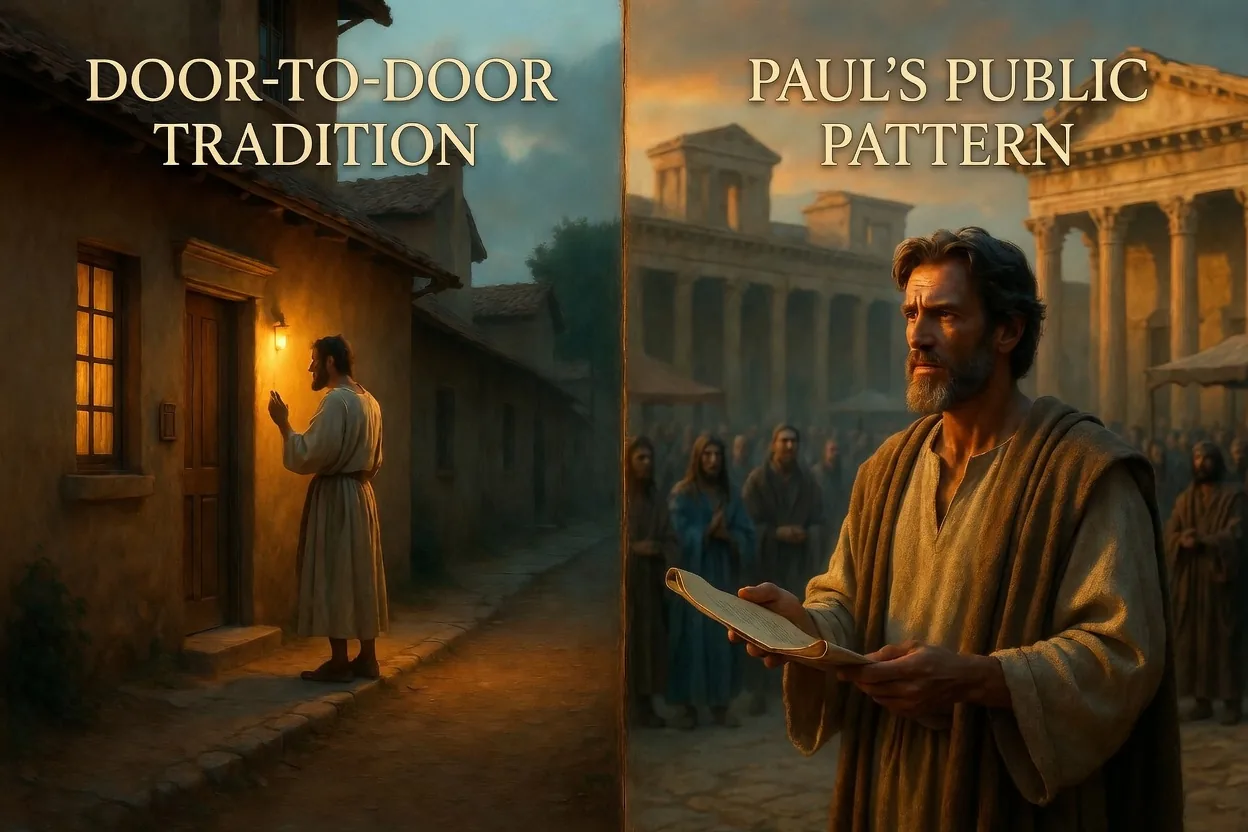
Walk into almost any traditional Baptist or evangelical church and you will find it somewhere on the calendar — visitation night. A team of faithful members fans out across the neighborhood, tracts in hand, knocking on doors, hoping to win a soul. The practice is treated as apostolic, as old as Christianity itself, and the verse most often cited in its defense is Acts 20:20. Paul himself, it is said, went "house to house." If Paul did it, we should do it too.
But did Paul actually teach or practice what modern churches call door-to-door visitation? And is Acts 20:20 really the foundation that tradition claims it to be? When you look carefully at what Paul wrote and what Paul did, the answer is far more instructive — and far more convicting — than the bumper-sticker version allows.
The Verse Everyone Cites
The go-to text is Acts 20:20, where Paul addresses the Ephesian elders at Miletus:
"And how I kept back nothing that was profitable unto you, but have shewed you, and have taught you publickly, and from house to house." (Acts 20:20 KJV)
On the surface, "from house to house" sounds exactly like what modern visitation programs do. But Acts 20 is a farewell address — Paul is speaking to elders of the church at Ephesus, not to a general audience. He is recounting his three-year ministry among them, to them. This is not an evangelistic methodology being handed down as a command. It is a personal testimony of pastoral faithfulness.
The phrase "from house to house" describes the location of Paul's teaching, not a strategy of cold-call outreach. In the first century, house churches were the primary gathering place of believers. Christians did not have dedicated buildings. They met in homes. When Paul says he taught "from house to house," he is saying he went to where the saints gathered — which happened to be private residences. He was serving existing believers in their homes, not knocking on strangers' doors to introduce the gospel.
To read Acts 20:20 as a mandate for modern door-to-door visitation is to import a 20th-century church program back into a first-century text. The verse simply does not say what the tradition claims it says.
What Paul Actually Did
If door-to-door cold-call outreach were Paul's primary evangelistic method, we would expect to see it reflected consistently across the book of Acts. What we actually find is something quite different.
Paul reasoned in synagogues. Wherever Paul went, his first stop was the local synagogue, where Jews and God-fearing Gentiles were already gathered and already had a framework for understanding the Scriptures:
"And Paul, as his manner was, went in unto them, and three sabbath days reasoned with them out of the scriptures." (Acts 17:2 KJV)
This was not random door-knocking. It was purposeful, contextual engagement with people who were already seeking.
Paul preached in public spaces. In Athens, Paul did not canvass the residential streets. He went to where people were already gathering and discussing ideas:
"Therefore disputed he in the synagogue with the Jews, and with the devout persons, and in the market daily with them that met with him." (Acts 17:17 KJV)
The Areopagus address that follows is one of the most celebrated moments in Paul's ministry — and it took place in a civic forum, not on a doorstep.
Paul taught in rented halls. At Ephesus, after being expelled from the synagogue, Paul did not pivot to neighborhood canvassing. He rented a lecture hall:
"But when divers were hardened, and believed not, but spake evil of that way before the multitude, he departed from them, and separated the disciples, disputing daily in the school of one Tyrannus." (Acts 19:9 KJV)
This continued for two years. The method was sustained public teaching in a central location — people came to Paul, not the other way around.
Paul used chains as a pulpit. In his imprisonment, Paul did not lament that he could no longer conduct visitation. He recognized that his captivity had actually advanced the gospel:
"But I would ye should understand, brethren, that the things which happened unto me have fallen out rather unto the furtherance of the gospel; So that my bonds in Christ are manifest in all the palace, and in all other places." (Philippians 1:12–13 KJV)
God's sovereign working, not a programmatic strategy, was the engine of the gospel's spread.
What Paul Wrote
If door-to-door visitation were a Pauline practice meant to be reproduced by the Body of Christ, Paul had ample opportunity to command it in his epistles. He wrote thirteen letters containing detailed instructions for Christian living, church order, relationships, finances, prayer, and conduct. Not once does he command believers to go door to door.
What Paul does say about conduct toward unbelievers is instructive precisely because of what it does not say:
"Walk in wisdom toward them that are without, redeeming the time. Let your speech be alway with grace, seasoned with salt, that ye may know how ye ought to answer every man." (Colossians 4:5–6 KJV)
This is not a program. It is a posture. Walk wisely. Speak graciously. Be ready to answer. The assumption embedded in these verses is that unbelievers will ask questions — that the believer's life, conduct, and speech will provoke curiosity and open doors naturally. Paul is not describing believers hunting for strangers to engage. He is describing believers living in such a way that conversations about the gospel arise organically.
Similarly, in Ephesians 6:19–20, Paul asks for prayer that he would open his mouth boldly to make known the mystery of the gospel. His concern is bold, clear proclamation — not structured canvassing. The boldness he seeks is about the content and courage of his speech, not about a method of delivery.
The Tradition vs. The Truth
Door-to-door visitation is a church tradition, not a Pauline doctrine. Its modern form largely developed in the 20th century through organized evangelism movements and denominational programs. It is not without good intentions — the desire to reach the lost is right and honorable. But good intentions do not make a tradition apostolic. Paul warned:
"Beware lest any man spoil you through philosophy and vain deceit, after the tradition of men, after the rudiments of the world, and not after Christ." (Colossians 2:8 KJV)
When a church program gets elevated to the level of biblical mandate — when members are made to feel guilty for not participating in visitation night, or when a ministry's faithfulness is measured by its door-knocking statistics — something has gone wrong. A man-made tradition has been given the authority of Scripture. That is precisely the pattern this ministry exists to expose.
It is also worth noting that Acts 20, the very passage most commonly cited, is in the book of Acts — a transitional book that spans multiple dispensations and records the history of God's dealings through Israel's apostles as well as through Paul. Not everything in Acts is doctrine for the Body of Christ today. The criterion is always what Paul taught and wrote in his epistles, rightly divided. And in those epistles, the methodology of door-to-door visitation simply does not appear.
What We Are Called To
None of this means believers should be silent or passive about the gospel. Paul is emphatic that the gospel of the grace of God must be proclaimed:
"For though I preach the gospel, I have nothing to glory of: for necessity is laid upon me; yea, woe is unto me, if I preach not the gospel!" (1 Corinthians 9:16 KJV)
The burden for souls is real. The urgency of the message is real. But the method matters, because the method shapes the message. When the gospel is reduced to a sales script rehearsed on a doorstep, it risks becoming a transaction rather than a proclamation of grace. When people feel coerced or caught off guard, the message of free grace can be obscured by the pressure of the encounter.
Paul's pattern was to go where people had already gathered — synagogues, marketplaces, lecture halls — and to reason from the Scriptures with those who were open. His conduct was winsome. His speech was seasoned with salt. He answered questions. He did not manufacture encounters through a structured canvassing program. He lived and spoke in such a way that the gospel had room to do its own work.
The Body of Christ today is called to the same. Live wisely. Speak graciously. Know how to answer. And when someone asks why you believe what you believe — be ready. That is the Pauline pattern. It is not a program you run on Tuesday nights. It is a life you live every day.
"Walk in wisdom toward them that are without, redeeming the time. Let your speech be alway with grace, seasoned with salt, that ye may know how ye ought to answer every man." (Colossians 4:5–6 KJV)
© 2026 Edward R. Cross




Comments
No comments yet. Be the first to share your thoughts.
Leave a comment