Library of Articles

The Will of God for the Body of Christ: Found in Paul, Not in Signs and Fleeces
Posted by Edward Cross on June 15, 2026
Believers leaving experiential Christianity are still taught to find God's will by signs, fleeces, open doors, and inner promptings. Paul knows none of it. This study lays out the grace believer's real path to God's will: largely revealed and plainly stated, the rest proved by a renewed mind walking in wisdom, the outcome trusted to providence.

Did Paul Write Hebrews, and Why It Doesn't Matter
Posted by Edward Cross on June 14, 2026
The epistle to the Hebrews names no human author, and faithful men have argued the point for two thousand years. This companion study lays out the full case for Pauline authorship and the full case against, weighs each, and shows why the answer changes no doctrine — a letter is governed by its audience, not its penman.
But Jesus Said… — Answering the Red-Letter Reflex
Posted by Edward Cross on June 13, 2026
When someone answers the gospel of grace with a verse in red, the real question is never whether Jesus said it, but to whom and under what program. This study gives one diagnostic question and applies it to the texts most often quoted — the rich young ruler, judge not, Lord Lord, endure to the end — showing each belongs to Israel's kingdom program,…
Progressive Revelation Within Each Program — Not Between Them
Posted by Edward Cross on June 13, 2026
There is real progressive revelation within each of God's programs, but none between them. The kingdom program does not ripen into the mystery, and the mystery does not collapse back into the kingdom — as Christ's command to keep the law, given after the cross in the Great Commission, makes plain.

No Such Thing as a Christian Sabbath or Holy Day: Contradictions in Terms
Posted by Edward Cross on June 11, 2026
The Sabbath was Israel's covenant sign — never given to the Body of Christ. This article examines Seventh-day Sabbatarians, Sunday-as-Sabbath Christians, and the church holy day calendar, showing why the unspoken requirement to observe certain days is the most oppressive form of calendar bondage. Paul settles it in Colossians 2:16.
The Blood of Christ and the Preaching of the Cross: Why Paul Could Not Preach a Bloodless or Generic Death
Posted by Edward Cross on June 11, 2026
The blood of Christ is the heart of the gospel Paul preached. This study traces what the blood accomplishes — propitiation, redemption, justification, reconciliation — and shows why Christ could not save by dying just any way. The shed blood and the cross were necessary, foretold in the Scriptures, and proven accepted by the resurrection.
Who Is Paul Protecting? Answering the Colossians 2 Objection
Posted by Edward Cross on June 11, 2026
A Facebook post claims Paul only taught believers not to be judged for keeping days — not that they should stop. This article examines the direction of Colossians 2:16, the Acts 15 council ruling, and what Paul's delight in the law actually means.
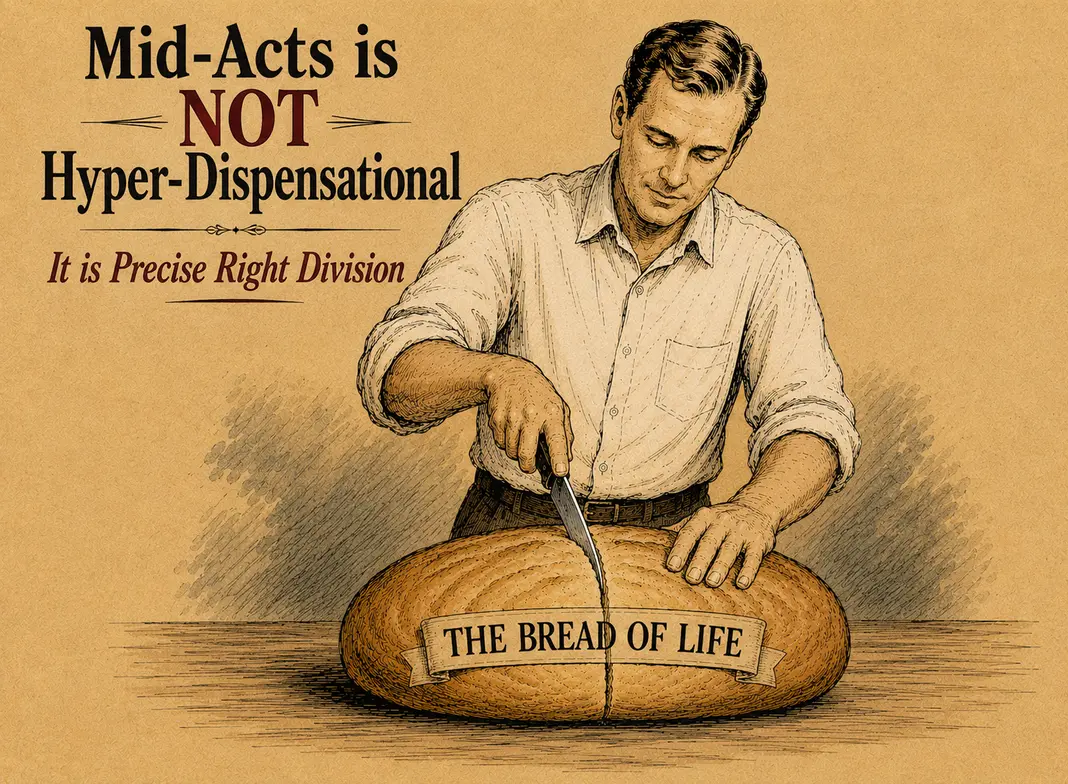
Rightly Dividing or Wrongly Accusing: A Response to Ruckman's Attack on Mid-Acts Dispensationalism
Posted by Edward Cross on June 10, 2026
Peter Ruckman's 1985 booklet attacking Mid-Acts dispensationalism substitutes ridicule for exegesis. This systematic response examines each argument on its merits — showing that Ruckman's scriptural case is weaker than his confidence suggests, his own dispensationalism has fewer proofs than ours, and the apostle Paul's plain words about his own gos…

{{item.title}}
Posted by {{item.author.name}} on {{ item.date_published|date("F j, Y") }}
{{item.excerpt|truncate(350)}}